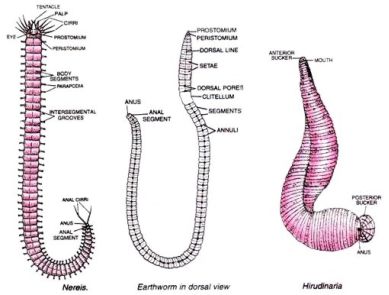
Annelida:
- Annelids may be aquatic (marine and freshwater) or terrestrial.
- They are free living or parasitic.
- Nephridia (sing.: nephridium) help in osmoregulation and excretion.
- Neural system contains paired ganglia (sing. ganglion) connected through lateral nerves to a double ventral nerve cord.
Characteristics-
- Body Organisation:
- Annelids are triploblastic organisms, meaning they have three germ layers: ectoderm, mesoderm, and endoderm.
- They exhibit organ-system level of body organisation and show bilateral symmetry.
- They exhibit a segmented body plan, with each segment called a metamere.
- Annelids have a coelom (body cavity) that provides space for organ systems.
- They possess a closed circulatory system, with blood contained within vessels.
- Locomotion:
- Annelids exhibit diverse modes of locomotion.
- Many annelids, such as earthworms, move by peristaltic contractions of their longitudinal and circular muscles, allowing them to burrow through soil or crawl on surfaces.
- Some marine annelids, such as polychaetes, possess bristle-like structures called setae that aid in movement and provide traction.
- Aquatic annelids like Nereis possess lateral appendages, parapodia, which help in swimming.
- Reproduction:
- Annelids can reproduce both sexually and asexually.
- Asexual reproduction occurs through fragmentation, where a fragment of the worm can regenerate into a complete organism.
- Sexual reproduction involves the presence of separate sexes (male and female).
- Nereis is dioecious (having the male and female reproductive organs in separate individuals).
- Earthworms and leeches are monoecious (having both the male and female reproductive organs in the same individual).
- Most annelids have internal fertilisation, with sperm transferred to the female reproductive organs.
- Feeding Strategies:
- Annelids exhibit various feeding strategies depending on their ecological niche.
- Many annelids are detritivores, feeding on decomposing organic matter in soil or sediment.
- Some annelids are filter feeders, using specialised structures like tentacles or ciliated structures to capture small particles from water.
- Predatory annelids may have specialised mouthparts or jaws to capture and consume prey.
- Examples:
Nereis, Pheretima (Earthworm) and Hirudinaria (Blood sucking leech).