EARTHWORM
- Earthworms are reddish-brown terrestrial invertebrates.
- They primarily inhabit the upper layers of moist soil.
- During the daytime, earthworms live in burrows, which they create by boring into the soil and swallowing it.
- In gardens, earthworms can be identified by their faecal deposits, known as worm castings, which they leave behind in the soil.
- Common Indian earthworm species include Pheretima and Lumbricus.
- Earthworms are often referred to as the "friends of farmers" because of their beneficial activities in the soil.
- They create burrows in the soil, making it porous and improving aeration, which benefits both soil respiration and the penetration of developing plant roots.
- The earthworm's contribution to enhancing soil fertility through its activities is known as "vermicomposting," a process where organic matter is broken down and converted into nutrient-rich vermicompost by earthworms.
- Earthworms are also utilized as bait in the sport of game fishing, where they serve as an effective and widely used bait for attracting fish.
Morphology of Earthworm
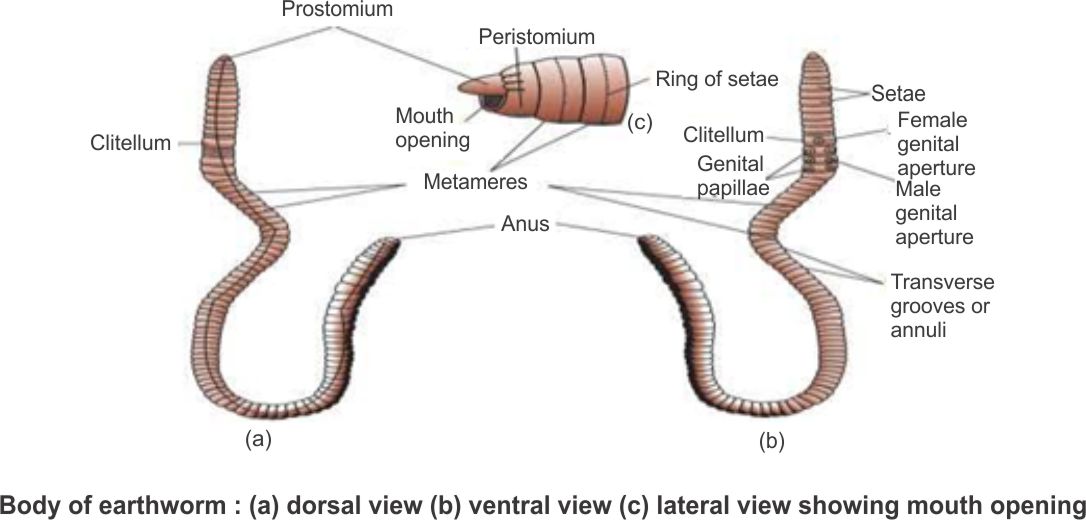
- Earthworms possess a long, cylindrical body that is divided into over a hundred short, similar segments or metameres (approximately 100-120 in number).
- The dorsal surface of the earthworm's body is characterized by a dark median mid-dorsal line, which represents the dorsal blood vessel running along the longitudinal axis.
- The ventral surface of the earthworm has genital openings (pores).
- The anterior end of the earthworm includes the mouth and the prostomium, a sensory lobe that covers the mouth and aids in forcing open cracks in the soil for burrowing.
- The first body segment is known as the peristomium (buccal segment), housing the mouth.
- In mature earthworms, segments 14-16 are covered by a prominent dark band of glandular tissue called the clitellum.
- The body is divisible into three main regions: preclitellar, clitellar, and postclitellar segments.
- Four pairs of spermathecal apertures are situated on the ventro-lateral sides of intersegmental grooves, specifically in segments 5-9.
- A single female genital pore is located on the mid-ventral line of the 14th segment.
- A pair of male genital pores are present on the ventro-lateral sides of the 18th segment.
- The body surface features numerous minute pores known as nephridiopores.
- In each body segment, except for the first, last, and clitellum, there are rows of S-shaped setae, which are embedded in epidermal pits in the middle of each segment.
- Setae can be extended or retracted and play a vital role in the earthworm's locomotion.