Mollusca:
- Molluscs are the second largest animal phylum.
- Molluscs can be terrestrial or aquatic
- They have respiratory and excretory functions.
Characteristics-
- Body Organisation:
- Molluscs are triploblastic organisms with bilateral symmetry.
- Molluscs exhibit organ- system level of organisation and are coelomate animals.
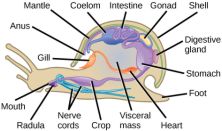
- They have a soft body covered by a mantle, which may secrete a protective shell made of calcium carbonate in many species.
- Molluscs typically exhibit three main body parts: the head, visceral mass (containing organs), and foot (used for locomotion).
- The anterior head region has sensory tentacles.
- Locomotion:
- Molluscs employ various modes of locomotion.
- Many molluscs use a muscular foot for crawling, burrowing, or attachment to surfaces.
- Some molluscs, like snails, move by rippling waves of muscle contractions called "foot crawling."
- Certain molluscs, such as squid and octopuses, are highly adapted swimmers using jet propulsion.
- Reproduction:
- Molluscs can reproduce both sexually and asexually.
- Sexual reproduction involves separate sexes (male and female).
- Fertilisation is usually internal, with the transfer of sperm from males to females.
- Some molluscs exhibit direct development, with offspring resembling miniature adults.
- Others undergo indirect development, with larval stages before reaching the adult form.
- Feeding Strategies:
- Molluscs exhibit diverse feeding strategies depending on their ecological niche and feeding apparatus.
- Most molluscs are herbivores or filter feeders, consuming algae, plant matter, or suspended particles.
- Some molluscs are carnivores, preying on other organisms.
- Molluscs possess specialised feeding structures, such as radula (a toothed ribbon) in snails and beak-like jaws in cephalopods.
- Examples:
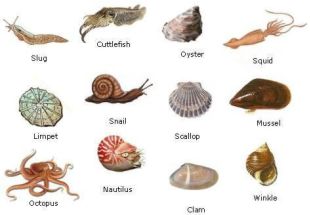
Pila (Apple snail), Pinctada (Pearl oyster), Sepia (Cuttlefish), Loligo (Squid), Octopus (Devil fish), Aplysia (Sea-hare), Dentalium (Tusk shell) and Chaetopleura (Chiton).