Electric Current
Electrons are negatively charged particles hence when they move, a number of charges moves, and this movement of electrons as is termed as electric current. It should be noted that the number of electrons that are able to move governs the ability of a particular substance to conduct electricity.
Electrons are minute particles that exist within the molecular structure of a substance. The electrons are tightly held, and other times they are loosely bounded. When electrons are loosely bounded by the nucleus, they are able to travel freely within the limits of the body.
Definition:
Electric Current is the rate of flow of electrons in a conductor.
The SI Unit of electric current is the Ampere (A) .
"Ampere is defined as one coulomb of charge moving in one second".
Types of Current Electricity
There are two types of current electricity as follows:
· Direct Current (DC)
· Alternating Current (AC)
Direct Current
The current electricity whose direction remains the same is known as direct current. Direct current is defined by the constant flow of electrons from a region of high electron density to a region of low electron density. DC is used in many household appliances and applications that involve a battery.
Alternating Current
The current electricity that is bidirectional and keeps changing the direction of the charge flow is known as alternating current. The bidirectionality is caused by a sinusoidally varying current and voltage that reverse directions, creating a periodic back and forth motion for the current. The electrical outlets at our home and industries are supplied with alternating current.
Generation of Current Electricity
Current electricity can be generated by the following methods:
- By moving a metal wire through a magnetic field (Both alternating current and direct current can be generated by the following method)
- By a battery through chemical reactions (Direct current can be generated through this method)
How a Current Flow in a Conductor?
The circuit includes a battery that produces voltage. Without voltage, electrons move randomly and are undirected; hence current cannot flow. Voltage creates pressure on the electrons, which accelerates them to flow in a single direction. This forms a closed conducting loop through which electrons can flow.
Electromotive Force:
The force that acts on the electrons to make them move in a certain direction is known as electromotive force, and its quantity is known as voltage and is measured in volts.
Symbol for Electromotive Force
The electromotive force symbol isε.
Electromotive Force Formula
ε = V + Ir
Where,
- V is the voltage of the cell
- I is the current across the circuit
- r is the internal resistance of the cell
- ε is the electromotive force
Unit of EMF
The unit for electromotive force is Volt.
EMF is numerically expressed as the number of Joules of energy given by the source divided by each Coulomb to enable a unit electric charge to move across the circuit.
EMF dimension is given as M1L2T-3I-1
Difference between Electromotive Force and Potential Difference
|
Electromotive Force |
Potential Difference |
|
EMF is defined as the work done on a unit charge |
Potential difference is defined as the energy which is dissipated as the unit charge pass through the components |
|
EMF remains constant |
Potential difference is not constant |
|
EMF is independent of circuit resistance |
The potential difference depends on the resistance between the two points during the measurement |
|
Due to EMF, electric, magnetic, and the gravitational field is caused |
Due to the potential difference, the only electric field is induced |
|
It is represented by E |
It is represented by V |
Electromotive Force Be Negative
Yes, the electromotive force can be negative. Consider an example where an inductor is generating the EMF such that it is opposing the incoming power. Then the produced EMF is taken as negative as the direction of flow is opposite to the real power. Therefore, the electromotive force can be negative.
Conventional Current flow Vs Electron Flow
Conventional Current Flow
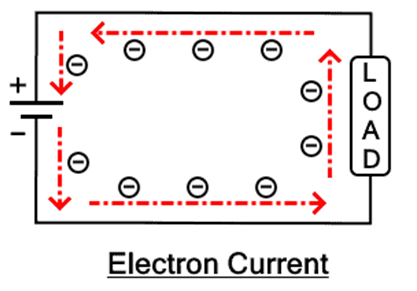
The conventional current flow is from the positive to the negative terminal and indicates the direction in which positive charges would flow.
Electron Flow
The electron flow is from negative to positive terminal. Electrons are negatively charged and are therefore attracted to the positive terminal as unlike charges attract.
Drift Velocity:
Definition:
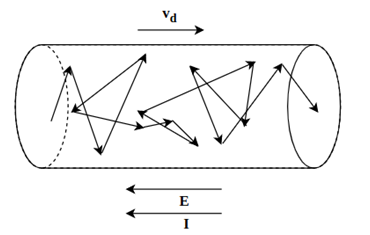
The average velocity attained by charged particles, (eg. electrons) in a material due to an electric field.
The SI unit of drift velocity is m/s.
The subatomic particles like electrons move in random directions all the time. When electrons are subjected to an electric field they slowly drift in one direction, in the direction of the electric field applied. The net velocity at which these electrons drift is known as drift velocity.
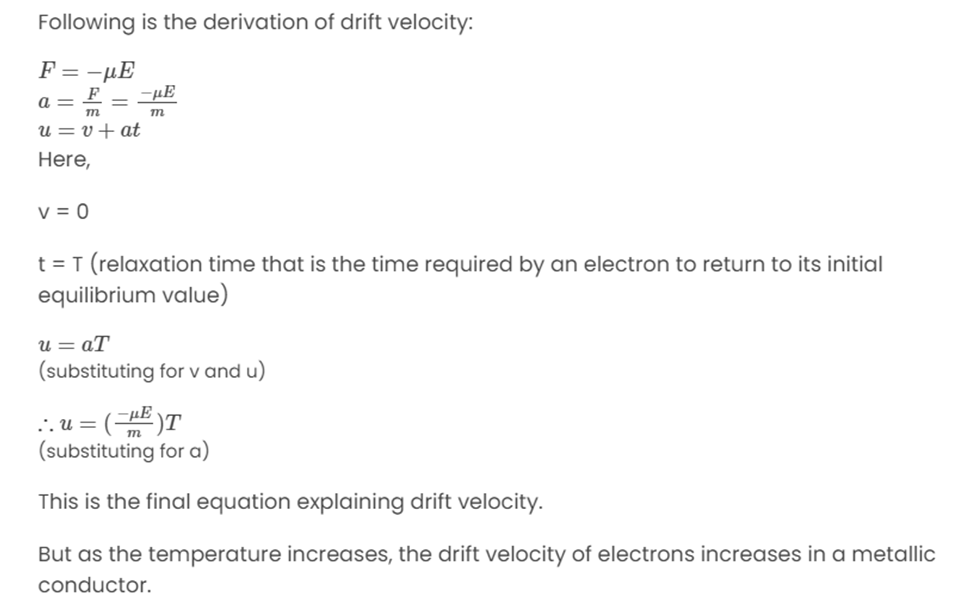
Derivation of Drift velocity:-
Mobility of an electron:
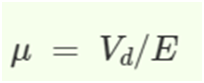
The drift velocity of an electron for per unit electric field is known as mobility of the electron.
Mobility of an electron can be calculated by:
Relation between Drift Velocity and Electric Current
Suppose, I is the current flowing through the conductor which is measured in amperes
n is the number of electrons
A is the area of the cross-section of the conductor which is measured in m2
v is the drift velocity of the electrons.
Q is the charge of an electron which is measured in Coulombs.
Then,
I = nAvQ
Relation between Drift Velocity and Current Density
Current Density:
The total amount of current passing through a unit cross-sectional conductor in unit time. We know the formula for drift velocity as:
I = nAvQ
J = I/A = nVQ
Where,
J is the current density measured in Amperes per square meter
v is the drift velocity of the electrons
The drift speed of electrons and their current density are directly proportional to each other. Also, when the electric field strength increases, the drift velocity increases and the current through the conductor also increases.