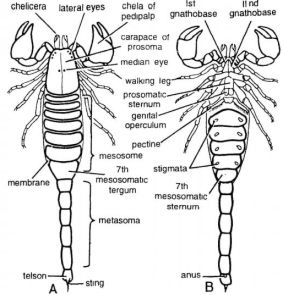
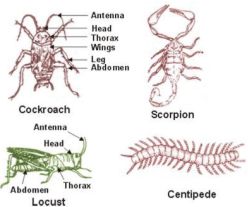
Arthropoda:
- It is the largest phylum of Animalia.
- More than 2/3rd of all named species on earth are arthropods.
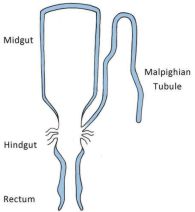
- Excretion takes place by the malpighian tubules.
Characteristics-
Body Organisation:
- Arthropods are triploblastic, coelomate animals. The organisms with bilateral symmetry.
- Have an organ system level of organisation.
- They possess a segmented body divided into distinct regions, such as head, thorax, and abdomen.
- Arthropods have an exoskeleton made of chitin, providing protection and support.
- They possess jointed appendages, allowing for a wide range of movements.
- Sensory organs such as antennae, compound and simple eyes, statocysts or balancing organs are present.
Locomotion:
- Arthropods exhibit diverse modes of locomotion.
- Most arthropods use jointed appendages to walk, run, swim, or fly.
- Appendages can be modified for specific functions, such as walking legs, swimming paddles, or wings.
- Some arthropods, like spiders, can produce silk for web-building and movement.
Reproduction:
- Arthropods reproduce sexually, with separate sexes (male and female) i.e. dioecious.
- Fertilisation is usually internal, with the transfer of sperm from males to females.
- Mostly are oviparous.
- Some arthropods undergo indirect development, with distinct larval stages before reaching the adult form.
- Others exhibit direct development, where the offspring resemble miniature adults.
Feeding Strategies:
- Arthropods exhibit diverse feeding strategies depending on their ecological niche.
- Many arthropods are herbivores, feeding on plants or plant materials.
- Some are carnivores, preying on other animals.
- Others are omnivores, consuming both plant and animal matter.
- Arthropods possess specialised mouthparts, such as mandibles or sucking mouthparts, adapted for their specific feeding habits.
Examples:
- Apis (Honey bee), Bombyx (Silkworm), Laccifer (Lac insect) are economically important insects.
- Anopheles, Culex and Aedes (Mosquitoes) are vectors.
- Locusta (Locust) is a Gregarious pest and Limulus (King crab) is a living fossil.
- Prawn, scorpion, butterfly, etc. are some more examples of arthropods.